Diving in Galápagos
Sea temperatures of 25–28 °C (76–82 °F) through the year, and 19 facts from official sources, each with the date we read it.
Overview
Wolf and Darwin can be dived only from a liveaboard, and many boats leave from San Cristobal. Land-based day diving runs from Puerto Ayora. DAN calls the islands intermediate to advanced, not a beginner trip. For Wolf and Darwin it asks for substantial time in challenging conditions, with strong currents and surge.
The year splits in two. January to May is the warm season, with calm seas, visibility of 12-30 m (40-100 ft) and water of 27.5 °C (82 °F) in March. June to December is the cooler garua season, with rougher seas, visibility of 5-18 m (15-60 ft) and water of 24.6 °C (76 °F) in August.
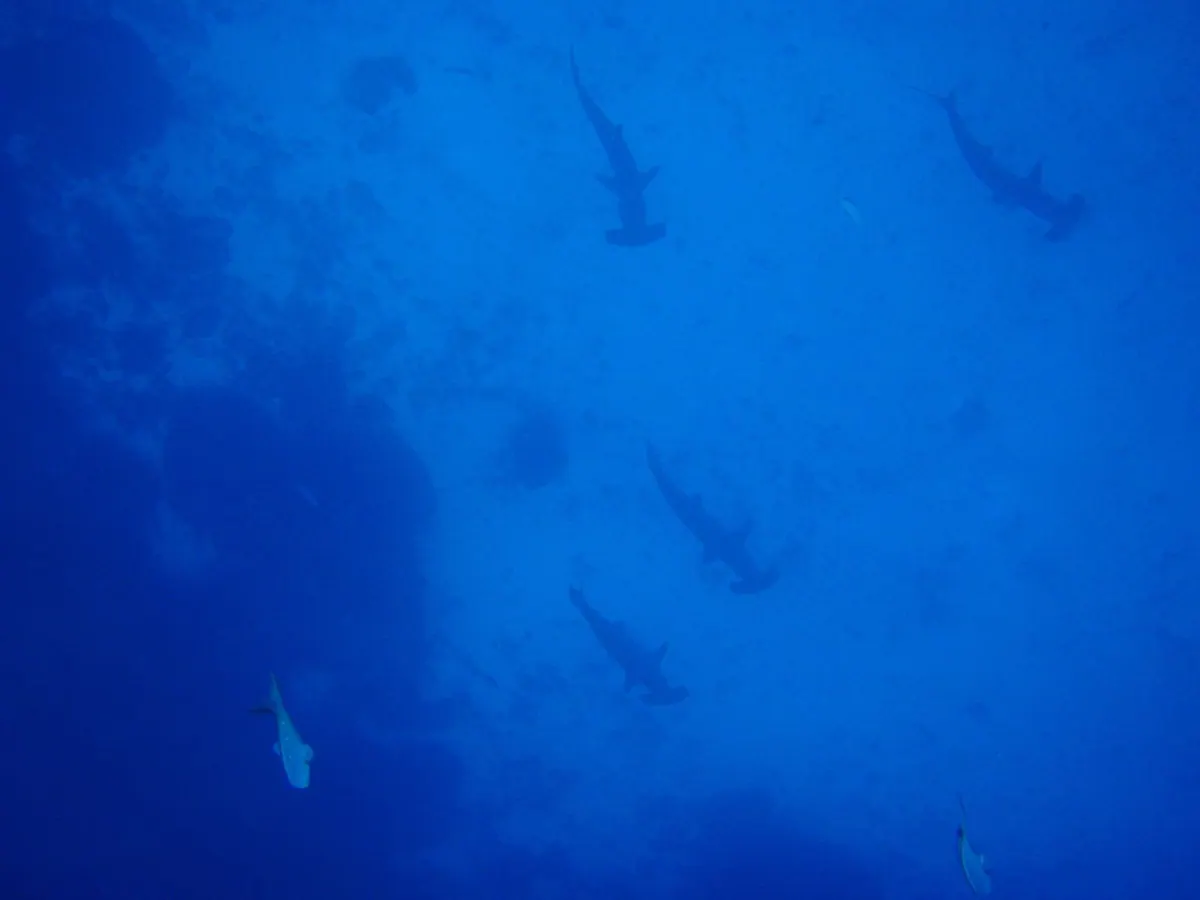
What you may see depends on the half of the year. January to May is manta season. Whale sharks are reported at Darwin's Arch from July through December, sometimes a half dozen on one dive. Hammerhead timing is less clear, with more reported in the cool season but Wolf counts highest in January.
The park entry fee is USD 200, or USD 100 under 12. Diving runs only through licensed tour operations. The rules allow one authorised guide per 8 divers, and liveaboard permits cover at most 16 passengers per boat.
Summary drafted with AI from the sourced facts below; not yet reviewed by John R. Each figure here appears, with its source, further down the page.
Not yet checked by a person. Each fact shows its source: an official page, or a dive operator's or magazine's report where it says so. Rules and fees change: check with the authority and your dive operator before you go. In an emergency: DAN hotlines. How we check facts. Spotted a mistake? corrections@divehomebase.com.
- Level
- Intermediate to advanced; not a beginner trip
- DAN Alert Diver, The Galapagos Islands, read 2026-11-22
- Sea temperature
- 24.6–27.5 °C / 76–82 °F
- NOAA OISST, monthly average 1991–2020
- Recompression chamber
- SSS Network Galapagos chamber (Protesub), 177 Marchena Avenue, Puerto Ayora, Santa Cruz
- SSS Network, Ecuador affiliate (operator's own site), read 2026-11-20
Sea temperature by month
Average sea surface temperature near Galápagos, 1991–2020. Deeper water and bays can be cooler. Best months for diving depend on more than temperature; we add them when a published source gives them.
- Jan26.2 °C / 79 °F
- Feb27.2 °C / 81 °F
- Mar27.5 °C / 82 °F
- Apr27.1 °C / 81 °F
- May26.4 °C / 80 °F
- Jun25.8 °C / 78 °F
- Jul24.9 °C / 77 °F
- Aug24.6 °C / 76 °F
- Sep24.8 °C / 77 °F
- Oct25.1 °C / 77 °F
- Nov25.0 °C / 77 °F
- Dec25.3 °C / 78 °F
Fees and permits
- 2001
- Consejo de Gobierno del Regimen Especial de Galapagos, read 2026-11-22
Rules for divers
1 rule, from Direccion del Parque Nacional Galapagos, Resolucion No. 26.
Set by the park or national authority. Breaking them can mean fines or losing your dive permit.
- Tour de Buceo Navegable (dive liveaboard): sea voyage on boats equipped for overnight stays, main feature scuba diving, no landing at park visit sites except those reachable from populated centres; maximum 16 passengers per permit and boat; permit quota capped at 14 for this category (and 40 daily dive tours); only sites in Park Directorate itineraries1
- Diving is operated only through a tourist operation quota and licence (Tour Diario de Buceo or Tour de Buceo Navegable) under the special tourism regulation; dive instruction needs a Park Directorate authorisation. One authorised Galapagos Adventure Guide per 8 divers; instruction groups max 6 per instructor; max 4 daytime dives a day plus one night dive, at most 3 night dives a week, each at most 1 hour; daytime dives 06:00-17:00, night dives 18:00-22:00; 20 minutes between groups at the same site; each site has a maximum number of groups at the same time; rebreathers allowed (max 1 hour per dive, guide must be certified on the type, group stays together)2
- Reglamento Especial de Turismo en Areas Naturales Protegidas (Decreto Ejecutivo 827, 2016, last amended 2022-09-26; copy hosted by Observatorio de Galapagos), read 2026-11-20
- Direccion del Parque Nacional Galapagos, Resolucion No. 26 (10 Apr 2018; Registro Oficial No. 259, 11 Jun 2018), hosted on FAOLEX, read 2026-11-20
Marine life and conservation
Most often reported: scalloped hammerhead (Jun–Dec), oceanic manta (Jan–May), whale shark (Jul–Dec).
Sightings are likelihoods, not promises.
- Protection: Galapagos National Park; entry fee funds conservation and management of the protected area run by the Galapagos National Park Office1
- Charles Darwin Foundation: hammerhead biomass about 21 t/ha in the cold season vs about 5 t/ha in the warm season at Darwin and Wolf; pregnant females aggregate in cold months (most often seen: Jun–Dec)2
- Manta season January to May: more mantas and other rays; hammerheads common but sometimes deeper (regularly seen: Jan–May)3
- Whale sharks at Darwin's Arch July through December, sometimes a half dozen on one dive (most often seen: Jul–Dec)3
- Consejo de Gobierno del Regimen Especial de Galapagos, read 2026-11-22
- Charles Darwin Foundation (blog on CDF-led study, 2017 survey data), read 2026-11-22 · read through a summary
- DAN Alert Diver, The Galapagos Islands, read 2026-11-22
When to go
Best months: Jan–May.
Seasons are averages: weather in any one year can differ. Storm seasons come from the national or regional weather agency.
- Best months: Jan–May1
- Rainy season: January to May warm season (afternoon showers, lots of sun); June to December cooler garua season, drier but overcast and misty1
- Wind and sea: Warm season: seas generally calm, 40 to 100 ft (12-30 m) visibility; cool season: rougher seas, 15 to 60 ft (5-18 m) visibility (Jan–May)1
- DAN Alert Diver, The Galapagos Islands, read 2026-11-22
Snorkelling and learning
- Snorkelling: Partly1
- DAN Alert Diver, The Galapagos Islands, read 2026-11-22 · read through a summary
Getting there
- Route: Fly from North America to Ecuador, then to the Galapagos to board; most liveaboards depart San Cristobal; land-based operators in Puerto Ayora1
- DAN Alert Diver, The Galapagos Islands, read 2026-11-22
Conditions
Visibility 12–30 m / 40–100 ft; currents strong with surge at Wolf and Darwin.
- Access: Liveaboard only for Wolf and Darwin (many depart San Cristobal); land-based day diving from Puerto Ayora1
- Best months: Jan–May1
- Currents: Strong with surge at Wolf and Darwin; rougher in the cool season (Jun-Dec); driver not stated1
- Diving: Liveaboard, drift, boat, wall, cold-water thermoclines1
- Visibility: 12–30 m / 40–100 ft1
- Visibility: 5–18 m / 15–60 ft1
- DAN Alert Diver, The Galapagos Islands, read 2026-11-22 · read through a summary
Galápagos in pictures
Dive sites
Bartolome
- Snorkel with Galapagos penguins at Isla Bartolome1
Darwin
- Level: Experienced1
- Whale shark sightings at Darwin are highly likely in the cool garua season (Jun-Dec) (most often seen: Jun–Dec)1
- Darwin counts highest in January and November, none seen in May (same 2008 census) (most often seen: Jan, Nov)2
- El Arco (Darwin) and El Arenal (Darwin) are authorised liveaboard dive sites; El Arco allows scuba, snorkel and night dive; maximum 4 groups at the same moment. Centre coordinates in the resolution: El Arco 1 40 18.42 N, 91 59 23.21 W; El Arenal 1 40 30.06 N, 91 59 34.59 W3
Wolf
- Currents: Strong currents and surge; Wolf has a healthy current; wind and current fight at Darwin's Arch1
- Level: Advanced: Wolf and Darwin, for divers with substantial time in challenging conditions1
- Wolf Island diver counts were significantly higher in January than other months and lowest in May (2008 census months Jan, May, Jul, Nov) (most often seen: Jan)2
- Authorised liveaboard dive sites at Wolf include Anchor Bay, El Derrumbre, Islote la Ventana, La Banana and Punta Shark Bay. El Derrumbre: scuba, snorkel and night dive allowed, 6 groups at once, centre 1 22 31.60 N, 91 48 55.29 W3
- DAN Alert Diver, The Galapagos Islands, read 2026-11-22 · read through a summary
- Hearn et al. 2010, Marine Biology 157:1899-1915 (peer reviewed), read 2026-11-22 · read through a summary
- Direccion del Parque Nacional Galapagos, Resolucion No. 26 (2018), read 2026-11-20
Questions about diving in Galápagos
When is the best time to dive the Galápagos?
It depends on the animal. January to May is the warm, calm season, and also manta season. Whale sharks are reported at Darwin's Arch from July through December, in rougher, cooler water.
Do you need to be an advanced diver for the Galápagos?
Yes for Wolf and Darwin, which are rated advanced for divers with substantial time in challenging conditions. DAN calls the islands as a whole intermediate to advanced, not a beginner trip.
How much is the Galápagos park fee?
USD 200, and USD 100 for children under 12. The fee funds conservation and management of the park.
When are whale sharks at Darwin's Arch?
From July through December, sometimes a half dozen on one dive. Sightings are described as highly likely in the cool garua season, June to December.
Not found yet: what it costs. We add facts once there is an official or published source. See every dive destination, or read about diving safety and how the site is paid for.